While equity markets continue to celebrate multi-hundred-billion-dollar AI backlog announcements, the global credit derivatives market has just flashed an unmistakable warning beacon.
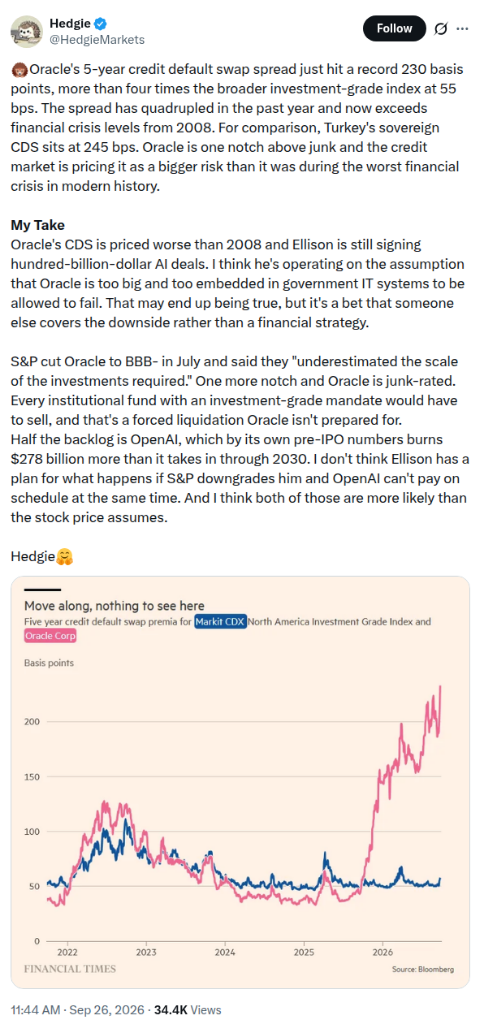
On September 26, 2026, market commentator Hedgie (@HedgieMarkets) published a chart sourced from Bloomberg and the Financial Times that quickly reverberated across trading desks:
“Oracle’s 5-year credit default swap spread just hit a record 230 basis points, more than four times the broader investment-grade index at 55 bps. The spread has quadrupled in the past year and now exceeds financial crisis levels from 2008. For comparison, Turkey’s sovereign CDS sits at 245 bps. Oracle is one notch above junk and the credit market is pricing it as a bigger risk than it was during the worst financial crisis in modern history.”
Credit markets are notoriously unsentimental. While equity analysts price growth on optimistic multi-year discount rates and management-guided TAMs (Total Addressable Markets), credit default swap (CDS) traders trade on one metric alone: the mathematical probability of default and capital recovery.
When a legacy technology titan with over $125 billion in total debt sees its CDS spread blow out from 40 bps to 230 bps—diverging violently from the broader investment-grade market—it is not noise. It is the bond market pricing in a structural liquidity crisis.
Beneath Oracle’s surging stock price lies a dangerous intersection of three existential forces:
- The S&P Downgrade to BBB-: Placing Oracle exactly one notch above speculative grade (“junk”), where a single-notch downgrade would trigger the largest “Fallen Angel” forced liquidation in world financial history.
- Extreme OpenAI Counterparty Concentration: Nearly 50% of Oracle’s headline $638 billion Remaining Performance Obligation (RPO) backlog is tied to an unprofitable AI startup projecting a $278 billion cumulative cash deficit through 2030.
- The “Too Big To Fail” National Security Gamble: Larry Ellison’s apparent bet that Oracle’s deep entrenchment in the Pentagon, intelligence community, and healthcare infrastructure guarantees a federal bailout if the AI infrastructure cycle fractures.
Let us conduct a forensic breakdown of the credit mechanics, the counterparty exposure, the fallen angel transmission mechanism, and what this means for the broader AI macroeconomic cycle.
1. Dissecting the Signal: What a 230 bps CDS Spread Really Means
To grasp the magnitude of the chart, one must understand how Credit Default Swaps (CDS) function and how investment-grade technology debt is typically valued.
A Credit Default Swap is an over-the-counter financial derivative that functions as insurance against a corporate or sovereign default. A spread of 230 basis points (bps) means that an institutional bondholder must pay $230,000 annually to insure $10 million of Oracle debt against default over a 5-year horizon ($2.30% \text{ per annum}$).
                  5-YEAR CREDIT SPREAD COMPARISON (SEPTEMBER 2026)
-----------------------------------------------------------------------------------------
Asset / Issuer                           5Y CDS Spread    Credit Rating (S&P / Moody's)
-----------------------------------------------------------------------------------------
Microsoft Corp. (MSFT)                   ~18 bps          AAA / Aaa
Alphabet Inc. (GOOGL)                    ~22 bps          AA+ / Aa2
Markit CDX NA Investment Grade Index     55 bps           Investment Grade Composite
U.S. High-Yield "BB" Crossover Index     ~210 - 240 bps   High Yield / Speculative
ORACLE CORP. (ORCL)                      230 bps          BBB- / Baa3 (Negative Outlook)
Republic of Turkey (Sovereign)           245 bps          B / B1 (Speculative Sovereign)
-----------------------------------------------------------------------------------------
The Three Alarming Divergences
-
The Quadruple Divergence from the CDX Index:
The Markit CDX North America Investment Grade Index represents a basket of 125 liquid North American investment-grade issuers. In September 2026, the index sits calmly at 55 bps, reflecting healthy macro liquidity and contained systemic stress. Oracle’s CDS spread of 230 bps is 4.18 times higher than its peer benchmark. This is not macro beta; it is idiosyncratic balance-sheet distress. -
Surpassing the 2008 Global Financial Crisis:
During the depths of the 2008 Lehman collapse, when global credit markets completely froze and counterparty risk spiked across the banking system, Oracle’s 5Y CDS briefly crossed 100–120 bps. At 230 bps today, credit derivatives traders view Oracle’s default risk as more than double its peak panic level during the worst financial crash in modern history. -
The Turkey Sovereign Equivalence:
Turkey is an emerging market economy with historically volatile foreign exchange reserves, double-digit inflation, and a speculative B/B1 sovereign rating (245 bps). That fixed-income markets are demanding virtually the same risk premium to insure Oracle’s corporate debt as they demand for Turkish sovereign debt illustrates how severely bond traders distrust Oracle’s balance sheet leverage.
2. The $125 Billion “Fallen Angel” Trap
Why is the market so panicked when Oracle is still technically classified as “Investment Grade”?
The answer lies in the liquidity cliff separating BBB- from BB+.
    INVESTMENT GRADE (IG)               HIGH YIELD ("JUNK")
+-----------------------------+     +-----------------------------+
| AAA  |  AA  |   A   |  BBB  |  |  |  BB+  |   BB   |    B   | CCC |
|                             |  |  |                             |
| Trillions in Institutional  |  |  | Speculative Funds, Family   |
| Mandates (Pensions/Insurers)|  |  | Offices, Distressed Debt    |
+-----------------------------+  |  +-----------------------------+
                                 |
                                 v
                     THE BBB- LIQUIDITY CLIFF
                     (Oracle currently: BBB-)
The S&P July 2026 Downgrade
On July 9, 2026, S&P Global Ratings downgraded Oracle’s long-term issuer credit rating from BBB to BBB-, maintaining a Negative Outlook.
BBB- is the absolute lowest investment-grade rung. In their downgrade statement, S&P credit analysts noted that they had:
“underestimated the scale of the capital investments and debt-financed infrastructure buildout required to support hyperscale AI expansion.”
S&P projected Oracle’s debt-to-EBITDA leverage to remain elevated in the mid-4x range into fiscal 2027—well above the typical 2.5x to 3.0x ceiling required for a stable investment-grade rating.
The Mechanics of Forced Liquidation
In corporate finance, a “Fallen Angel” is an issuer downgraded from investment-grade (BBB- or higher) into speculative/junk territory (BB+ or lower).
This transition is not merely a change in letters; it triggers an institutional mechanical sell-off:
- Chartered Investment Mandates: Trillions of dollars managed by sovereign wealth funds, state pension systems (e.g., CalPERS), corporate retirement plans, and life insurance companies have strict statutory or fiduciary charters that expressly forbid holding non-investment-grade debt.
- Index Expulsion: The core benchmark of global fixed income—the Bloomberg U.S. Aggregate Bond Index (“The Agg”)—as well as mega-ETFs like Vanguard Total Bond Market (BND) and iShares Investment Grade Corporate Bond ETF (LQD)—must automatically purge any bond that falls below BBB-/Baa3 at the end of the monthly rebalancing cycle.
- The Scale of the Dump: As of fiscal Q1 2027 (ended August 31, 2026), Oracle carries approximately $125.3 billion in total balance-sheet debt ($117.7 billion in long-term notes and $7.6 billion in current maturities), with some adjusted lease-inclusive metrics reaching $143.5 billion.
                HISTORICAL FALLEN ANGEL COMPARISON BY DEBT VOLUME
-----------------------------------------------------------------------------------------
Company                 Year Downgraded to Junk    Estimated Debt Downgraded
-----------------------------------------------------------------------------------------
General Motors (GM)     2005                       ~$30 Billion
Occidental Petroleum    2020                       ~$35 Billion
Ford Motor Company      2020                       ~$36 - $78 Billion
ORACLE CORP. (POTENTIAL) 2026 / 2027               ~$125+ BILLION (Record Breaking)
-----------------------------------------------------------------------------------------
If S&P or Moody’s cuts Oracle by just one notch to BB+, Oracle would instantly become the single largest Fallen Angel in world economic history.
The entire U.S. High-Yield bond market has an aggregate market value of roughly $1.4 trillion to $1.6 trillion. Dropping $125+ billion of Oracle paper into the junk bond market overnight would represent an instantaneous supply shock equal to nearly 8% to 10% of the entire asset class.
High-yield mutual funds and ETF liquidity could not absorb such an avalanche of supply without secondary market bond prices cratering to 70–80 cents on the dollar, causing borrowing costs for all speculative-grade companies to spike. This is why the CDS spread has blown out: derivatives traders are front-running the forced liquidation cliff.
3. The Counterparty Time Bomb: OpenAI’s $278 Billion Burn
If Oracle’s debt load is so precarious, why did Larry Ellison push the accelerator?
The catalyst was the race to win the artificial intelligence cloud war. With Amazon (AWS), Microsoft (Azure), and Google (GCP) dominating traditional enterprise cloud hosting, Oracle Cloud Infrastructure (OCI) positioned itself as the aggressive, low-overhead merchant of AI compute clusters—striking landmark partnerships with OpenAI, SoftBank, and Elon Musk’s xAI.
In recent earnings calls, Oracle celebrated a record $638 billion Remaining Performance Obligation (RPO) backlog, sending the stock surging.
However, credit rating agencies look past the headline backlog to evaluate customer concentration and counterparty solvency.
                     THE CIRCULAR AI FINANCING LOOP

            +-----------------------------------------------+
            |               Venture Capital / PE            |
            |      (Sovereign Funds, SoftBank, Tech Giants) |
            +-----------------------------------------------+
                                    |
                       Invests Equity / Liquidity
                                    v
            +-----------------------------------------------+
            |                    OPENAI                     |
            |   Pre-IPO Projections: -$278B FCF thru 2030   |
            |   Infrastructure Commitments: $856 Billion    |
            +-----------------------------------------------+
                                    |
                       Signs Long-Term GPU Leases
                        (~50% of Oracle's RPO)
                                    v
            +-----------------------------------------------+
            |                 ORACLE (OCI)                  |
            |   Borrows $125B+ to build data centers        |
            |   Signs 15-20 yr land/power PPAs              |
            +-----------------------------------------------+
                                    |
                       Buys NVL72 Racks / Silicon
                                    v
            +-----------------------------------------------+
            |               NVIDIA / HARDWARE               |
            |         Records Record GPU Revenues           |
            +-----------------------------------------------+
The Anatomy of the Counterparty Vulnerability
-
50% Backlog Concentration in One Entity:
According to S&P credit assessments, OpenAI accounts for approximately 50% of Oracle’s $638 billion RPO backlog. That means over $300 billion of Oracle’s projected multi-year revenue is dependent on the financial survival and contractual solvency of a single company. -
OpenAI’s $278 Billion Cash Burn Reality:
Internal financial figures circulated ahead of OpenAI’s planned corporate restructuring and pre-IPO capital raises reveal that OpenAI projects a cumulative negative free cash flow of $278 billion through 2030. To maintain its frontier model training and inference pipelines, OpenAI anticipates requiring $856 billion in total compute and infrastructure spend. -
The Fatal Asymmetry:
- Oracle’s Obligations are Hard and Inflexible: When Oracle signs 15-to-20-year Power Purchase Agreements (PPAs) with utility providers, leases thousands of acres of industrial land, and places multi-billion-dollar non-cancelable purchase orders for NVIDIA Blackwell (GB200/B300) clusters, those liabilities are fixed corporate debt and lease covenants.
- OpenAI’s Ability to Pay is Speculative and Variable: OpenAI’s payments depend on continuous, uninterrupted multi-billion-dollar funding rounds from global sovereign wealth funds and venture investors.
If venture capital risk appetite wanes, or if model capability gains face diminishing returns that dampen enterprise subscription growth, OpenAI will be forced to renegotiate, delay, or default on its compute reservations.
If OpenAI cannot pay on schedule, Oracle is left holding gigawatts of specialized, rapidly depreciating hardware, hundreds of millions in monthly power utility commitments, and a $125 billion debt stack with no corresponding cash flow to service it.
4. The “Too Big To Fail” Bet: Ellison’s Government Shield
In his viral commentary, Hedgie pointed to the psychological foundation of Ellison’s posture:
“I think he’s operating on the assumption that Oracle is too big and too embedded in government IT systems to be allowed to fail. That may end up being true, but it’s a bet that someone else covers the downside rather than a financial strategy.”
Is Larry Ellison delusional, or is he calculating a sovereign put?
Oracle’s integration into the core operating fabric of the United States federal government is almost impossible to overstate:
- The Pentagon (JWCC): Oracle is one of four authorized multi-cloud providers under the Department of Defense’s $9 billion Joint Warfighting Cloud Capability contract, powering tactical edge computing and top-secret defense operations.
- The Intelligence Community: Oracle Cloud for Government hosts classified workloads for the CIA, NSA, and Director of National Intelligence.
- Healthcare Infrastructure (Cerner): Oracle’s $28 billion acquisition of Cerner placed the electronic health records of the Department of Veterans Affairs (VA) and the Department of Defense Military Health System directly onto Oracle servers.
- Entitlement Distribution: The Social Security Administration, Medicare, and the Internal Revenue Service operate transactional relational database engines that run on Oracle hardware and software.
Ellison’s thesis appears clear: The United States government cannot allow Oracle to shut its doors. A cascading bankruptcy that shut down Oracle’s data centers would instantly paralyze national defense logistics, veteran healthcare, and federal tax collection.
Why “Too Big To Fail” Does Not Save Bondholders or Equity
The fatal flaw in the “Too Big To Fail” (TBTF) thesis is confusing the preservation of operations with the preservation of capital.
History offers harsh lessons for investors betting on federal bailouts:
- General Motors and Chrysler (2009): GM was deemed essential to the industrial base of the United States. The federal government intervened with tens of billions in TARP financing. The assembly lines never stopped, and auto workers kept building cars. Yet equity was wiped out to zero, and senior unsecured bondholders were forced to accept deep haircuts in a structured Chapter 11 reorganization.
- Fannie Mae and Freddie Mac (2008): The mortgage giants were the literal backbone of American homeownership. The government placed them into permanent conservatorship. The mortgages were paid, but common shareholders were essentially wiped out, and preferred equity lost 90%+ of its value.
Even in the most generous bailout scenario, if Oracle faces a debt crunch, the Department of Defense will step in to seize or protect its military databases and national security cloud regions.
The White House will not expend hundreds of billions of taxpayer dollars to service private corporate bonds issued to build speculative GPU clusters for OpenAI.
5. Connecting the Dots: The AI Debt Super-Cycle
This development must be viewed in tandem with our earlier investigation into Goldman Sachs’ September 2026 report on Hyperscaler AI Capital Expenditures.
In that analysis, we documented the $308 billion annual revenue hurdle required across the six major infrastructure operators simply to break even (0.0% ROIC) on Phase II AI capex ($1.22 trillion) against the ruthless 5-year depreciation cycle of GPU silicon.
THE EVOLUTION OF THE AI CAPITAL CYCLE
-----------------------------------------------------------------------------------------
Phase I (2023 - 2024): The Cash-Flow Harvest
- Players: Microsoft, Alphabet, Meta, Apple.
- Funding: 100% self-funded via massive search, ad, and software free cash flows.
- Leverage: Zero net debt; balance sheets resembling sovereign fortresses.
- Market Reaction: Unanimous institutional euphoria.

Phase II (2025 - 2026): The Leveraged Land Grab
- Players: Oracle, CoreWeave, Neo-cloud startups, utility joint ventures.
- Funding: High-yield syndicated loans, private credit, commercial paper, massive bond issues.
- Leverage: Debt-to-EBITDA rising to 4x - 5x; customer concentration in cash-burning startups.
- Market Reaction: CDS spreads blow out; S&P downgrades; bond markets front-run default.
-----------------------------------------------------------------------------------------
During Phase I, the AI boom was funded by the cash cows of Big Tech. Microsoft and Google could afford to write $30 billion checks for GPUs every year out of excess operating cash flow without taking on debt.
In Phase II, the race expanded from tens of megawatts to gigawatt-scale hyperscale campuses. To stay relevant against trillion-dollar balance sheets, Oracle chose to finance the buildout using leverage.
The 230 bps CDS spread on Oracle is the definitive signal that Phase II has reached its financial limit. Fixed-income investors are refusing to finance the next wave of speculative GPU infrastructure at investment-grade prices.
6. What to Watch: The 2026–2027 Stress Matrix
For technology executives, cloud architects, and institutional investors, the blowout in Oracle CDS signals several immediate milestones that will determine the trajectory of the AI economy:
| Milestone / Metric | Threshold to Watch | Impact / Consequence |
|---|---|---|
| S&P / Moody’s Rating Action | Cut below BBB- / Baa3 | Fallen Angel event: Triggers an estimated $50B–$80B in forced institutional selling from IG bond funds. |
| Oracle 5Y CDS Spread | Crosses 300 bps | Prices in imminent debt restructuring; bond markets effectively close to new unhedged debt issuance. |
| OpenAI Capital Raise | Timing & Valuation of pre-IPO rounds | If OpenAI cannot secure $30B+ in fresh equity, it will be forced to curtail OCI cluster commitments. |
| OCI Backlog (RPO) Cash Conversion | RPO-to-Revenue realization rate | Checks whether the $638B backlog is translating into actual GAAP operating cash flow or remaining deferred paper. |
| Secondary High-Yield Spreads | Spread between US HY Index & Oracle bonds | Measures whether high-yield debt funds are willing to absorb Oracle paper or demanding distressed yields (10%+). |
Conclusion: The Canary Has Sung
Historically, the credit market is the smartest money in the room.
In 2007, equity markets hit all-time highs while the ABX subprime mortgage index and Bear Stearns credit default swaps were flashing red. In the telecommunications crash of 2001, credit spreads on WorldCom and Global Crossing blew out months before corporate bankruptcies rewrote the fiber industry.
Today, equity investors are looking at Oracle’s headline backlog numbers and seeing an AI hypergrowth engine. But credit default swap traders are looking at $125+ billion in corporate debt, an S&P rating sitting on the edge of the junk abyss, and a single cash-burning startup accounting for half the order book.
At 230 basis points, the canary in the AI coal mine is not just chirping. It is gasping for air.